Chamomile vs Other Calming Essential Oils: What Trials Show
No trial we could find compares chamomile essential oil head to head with lavender, bergamot, clary sage or vetiver, so any ranking of "the best calming oil" is opinion dressed as data. What you can compare honestly is what each oil has actually been tested for, how, and what the skin-safety picture looks like. We sell only the two chamomile oils, so treat this as a fair outside look, including where chamomile is the wrong pick.
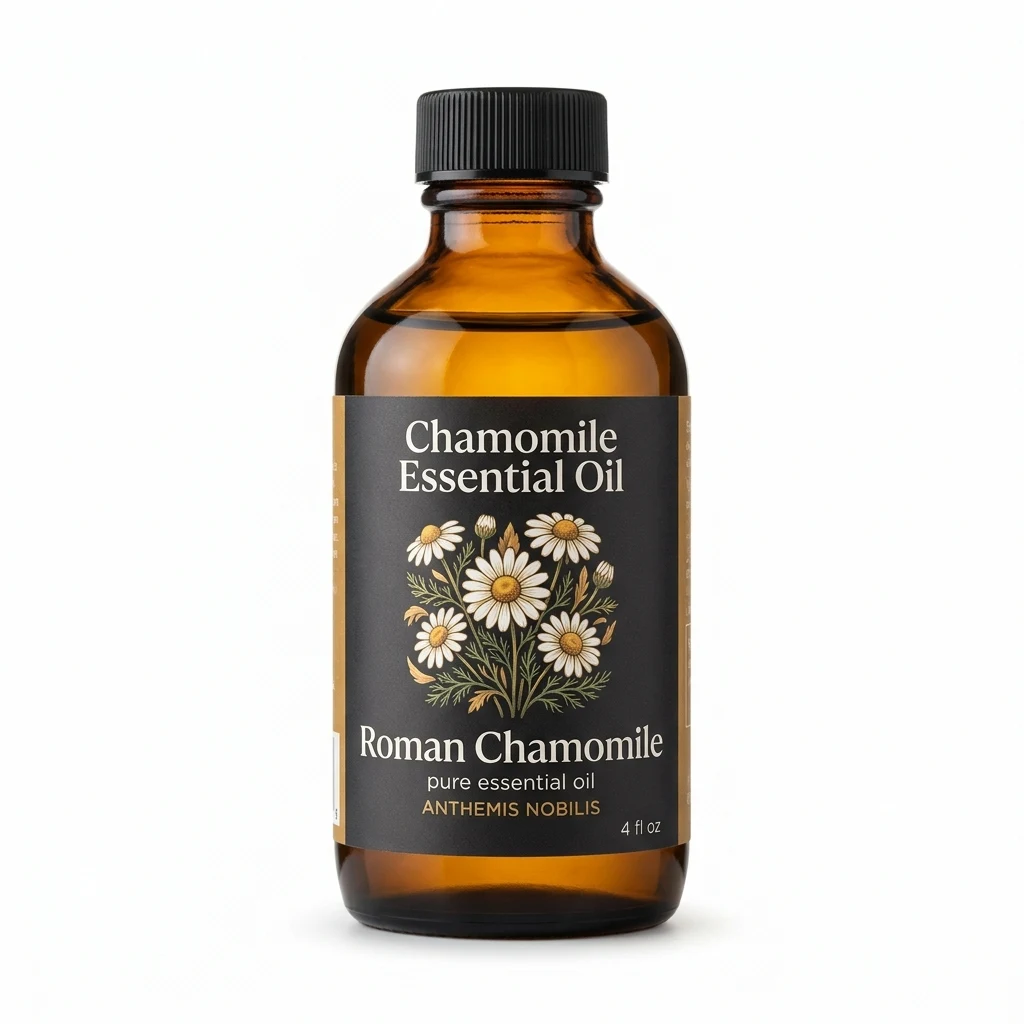
Roman Chamomile Essential Oil
Our own Roman Chamomile Essential Oil, in sizes from 0.5 oz to bulk.
From $32.99
Shop Now →Decide first: what are you doing with it?
- Skin, diluted (massage, body oil, bath): your main filters are allergy history and dilution, not which oil has the nicest reputation. Chamomile is a daisy-family plant, so a ragweed or Asteraceae allergy rules it out until an allergist or dermatologist says otherwise.
- Scent only (diffuser, linen spray): skin rules matter less; personal scent preference decides. Our Roman oil is described on its page as sweet, apple-like and herbaceous, and our blends page, oils that blend with chamomile, covers pairings.
- A medical symptom (persistent anxiety, insomnia, pain): no essential oil replaces seeing a physician. Skip the comparison and book the appointment.
- Pregnancy, a baby, or a pet in the house: ask an OB-GYN or midwife, a pediatrician, or a veterinarian before choosing any of these oils. We leave pregnancy flags out of the table below because we did not read a primary source we could cite for each oil.
The evidence matrix
This is what we read, not a complete literature. Where an oil is missing (ylang ylang, sweet marjoram, frankincense) it is because we found nothing we could read and cite, not because the oil is unstudied.
| Oil | Best evidence we read | What it was, and what it was not |
|---|---|---|
| Chamomile | Burkev et al., 2026: chamomile-lavender blend massage vs vetiver vs jojoba placebo, 108 ICU nurses randomised, 96 completed, nightly for 4 weeks | A blend, so chamomile cannot be separated from lavender. Concentration not stated. Single-blind, self-reported sleep, power analysis done after the fact, funded by a university research fund. |
| Lavender | Same blend trial; Henley et al., 2007: three prepubertal boys with breast enlargement that coincided with lavender and tea tree products | The blend confounds it. The 2007 report is three cases plus cell-line work, not proof of cause. |
| Vetiver | Same trial, as a single oil arm | Fatigue scores fell from 7.0 to 2.0 on vetiver, 7.5 to 2.0 on the chamomile-lavender blend, and 8.0 to 4.0 on jojoba. Both oil arms beat placebo; the record gives no direct oil-to-oil comparison. |
| Clary sage | Lee, Cho and Kang, 2014: 22 menopausal women in their 50s breathed clary sage oil | Cortisol fell significantly and serotonin rose. Outcomes were blood markers, not symptoms, and the abstract describes no control group. |
| Bergamot | Wakui et al., 2026: 57 undergraduates, aroma stones vs water stones for 3 days before exams | Open-label, so participants knew which they had. State anxiety was lower at 180 minutes on all 3 days; the DASS-21 scale showed no between-group difference. |
The sources are Burkev et al., Nursing in Critical Care, 2026, Lee et al., Phytotherapy Research, 2014, Wakui et al., J Integr Complement Med, 2026 and Henley et al., N Engl J Med, 2007.
What the pooled reviews add
Two recent reviews cover aromatherapy in general, not single oils. Pehlivan and Erbay Dalli, BMC Medical Education, 2026, meta-analysed 33 trials in 2,312 nursing and health-science students: anxiety fell (SMD -0.46), but stress did not change significantly. Moyano et al., Frontiers in Medicine, 2026, reviewed 18 trials in 1,236 adult ICU and cardiac patients: anxiety improved in 86% of outcomes, with high certainty, while certainty for physiological outcomes such as blood pressure was low to very low.
Reasoning from those numbers, the practical consequence is that the act (a ritual, a pause, a scent you like) may matter as much as the oil, and none of these reviews lets you pick chamomile over lavender or the reverse. If a page tells you one oil is "the best" for calm, ask which trial compared them. We did not find one. For our fuller take on that question, see chamomile oil for anxiety and stress, and for the live lavender pairing post, lavender and chamomile in the evening.
Skin flags that actually separate these oils
Chamomile's documented skin risk is cross-allergy within the daisy family. In Jovanovic et al., Medicinski pregled, 2004, 30 adults with atopic dermatitis were patch tested with a Compositae mix and plant extracts. Nine were sensitised, and chamomile was the most frequent single positive (5 of 9). That tested extract, not oil, in a small group, so it is an inference for our oils; our "Inside the Still" page carries the same ragweed and Asteraceae caution.
Bergamot's separate issue is sunlight. A 2026 review of citrus oils, Zhang et al., Chemistry & Biodiversity, lists furocoumarin-induced photosensitivity among its topics. We could not retrieve the current IFRA limit text, so we give no number. If you use bergamot on skin, check that figure at the source and read whether the bottle is a furocoumarin-free version.
For tea tree, which is also not ours, see our sibling piece, chamomile versus tea tree for skin, since its problem is oxidation rather than the plant family.
Dilution maths across oils
The Tisserand Institute's dilution ranges are by use, not by oil: 0.2 to 1% for reaction-prone or impaired skin, 0.5 to 1.2% for the face, 1 to 3% for body oils and lotions, 2 to 4% for bath products. The page does not mention chamomile. Our product pages list 0.5% to 2%. Taking 1 oz as 29.57 ml and 20 drops per ml (an approximation), one ounce of carrier holds about 591 drops:
| Use | Range | Drops per ounce at that range |
|---|---|---|
| Reaction-prone skin | 0.2 to 1% | about 1 to 6 |
| Face | 0.5 to 1.2% | about 3 to 7 |
| Body oil | 1 to 3% | about 6 to 18 |
Reasoning from this, our 2% ceiling sits above the facial range, so for a face use keep chamomile to the lower end. Recipes built from these ranges are arithmetic, not tested formulations; patch test first. Because our oils arrive undiluted, the carrier and the drops are yours to count, and the same count applies to any oil you buy elsewhere.
Where chamomile is not the best fit
- You have a ragweed, arnica or other Asteraceae allergy.
- You want an oil with its own head-to-head trial data: none of the oils above has one against chamomile, but clary sage and bergamot each have a small direct trial, while for chamomile the best we read was a blend.
- You want something to use in the sun on skin: that is a bergamot question, and chamomile is not a replacement for checking the limit.
- You need an ingestible option. Neither we nor this article recommend swallowing any essential oil; ask a physician.
If scent and allergy history point to chamomile, choose German for the deep blue oil or Roman for the sweet, apple-like one, and see German chamomile versus blue tansy if you are weighing it against a similarly coloured oil.
Roman Chamomile Essential Oil
Roman Chamomile Essential Oil from our own shop, in sizes from 0.5 oz to bulk.
From $32.99
Shop Now →Sources & Further Reading
- Burkev FG et al., 2026. Chamomile-lavender and vetiver aromatherapy massage for fatigue and sleep in ICU nurses. Nurs Crit Care. pubmed.ncbi.nlm.nih.gov/42630137
- Lee KB, Cho E, Kang YS, 2014. Changes in 5-hydroxytryptamine and cortisol plasma levels in menopausal women after inhalation of clary sage oil. Phytother Res. pubmed.ncbi.nlm.nih.gov/24802524
- Wakui N et al., 2026. Bergamot aroma stones and exam anxiety in undergraduates. J Integr Complement Med. pubmed.ncbi.nlm.nih.gov/42755326
- Pehlivan S, Erbay Dalli O, 2026. Aromatherapy in nursing and health sciences students: meta-analysis. BMC Med Educ. pubmed.ncbi.nlm.nih.gov/41495795
- Moyano PA et al., 2026. Aromatherapy in adult ICU and cardiac patients: systematic review. Front Med. pubmed.ncbi.nlm.nih.gov/42318382
- Henley DV, Lipson N, Korach KS, Bloch CA, 2007. Prepubertal gynecomastia linked to lavender and tea tree oils. N Engl J Med. pubmed.ncbi.nlm.nih.gov/17267908
- Jovanovic M et al., 2004. Contact allergy to Compositae plants in patients with atopic dermatitis. Med Pregl. pubmed.ncbi.nlm.nih.gov/15503788
- Zhang Y et al., 2026. Citrus essential oils: composition, extraction, activity and furocoumarin photosensitivity (review). Chem Biodivers. pubmed.ncbi.nlm.nih.gov/42105350
- Tisserand Institute. Dilution for essential oils. tisserandinstitute.org/dilution-essential-oils