Chamomile Oil vs Tea Tree Oil for Skin: Irritation vs Allergy
"Gentle chamomile versus strong tea tree" is the usual framing for this comparison, and it is the wrong axis. Both oils can cause allergic contact reactions, and the better-documented triggers are not strength but history: tea tree oil that has oxidised in a bottle, and chamomile in anyone already allergic to the daisy family. Below is what the papers actually measured, where tea tree has better skin evidence than chamomile oil, and when neither is the right call. We sell only the two chamomile oils, not tea tree.
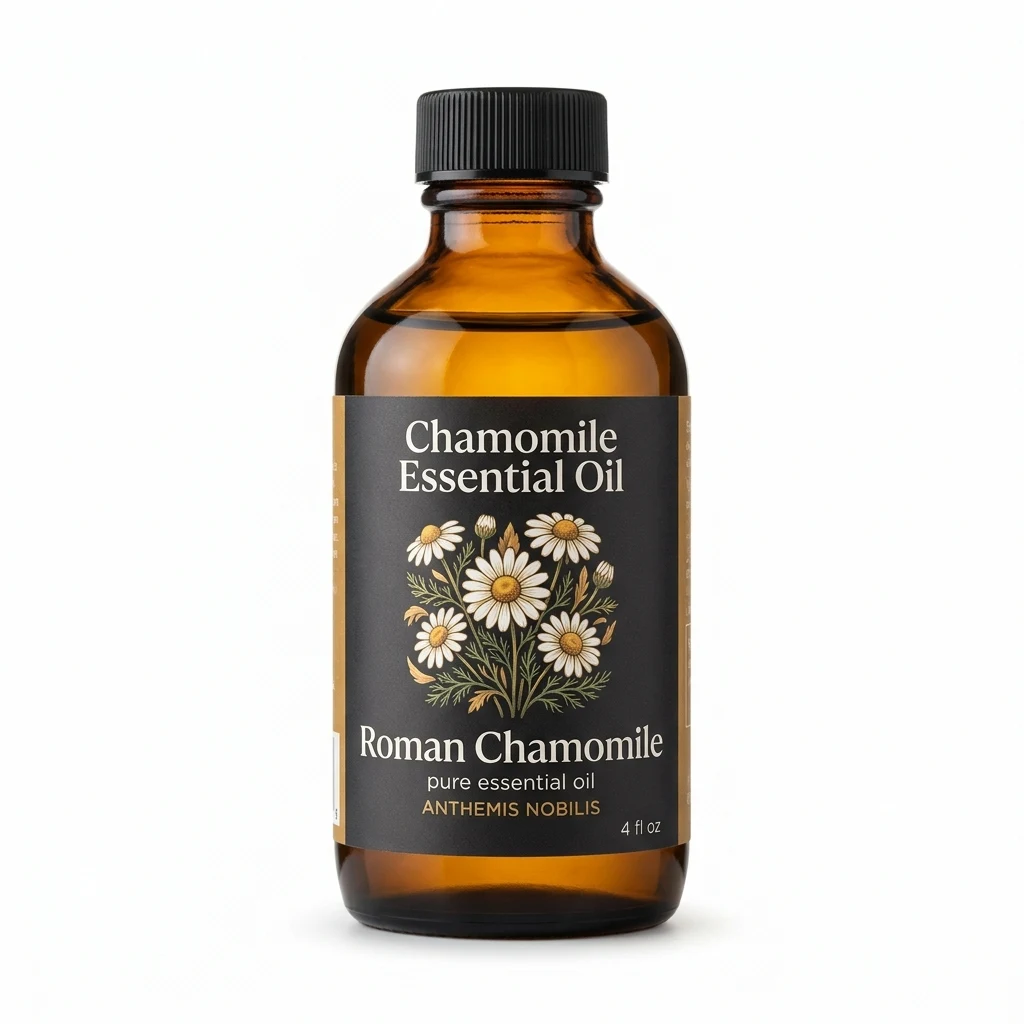
Roman Chamomile Essential Oil
Our own Roman Chamomile Essential Oil, in sizes from 0.5 oz to bulk.
From $32.99
Shop Now →Irritation and sensitisation are different problems
Irritation depends on how much oil touches the skin and shows up on contact. Sensitisation is an immune event that develops after exposure, which is why the patch-test literature below asks about prior use. "Gentle versus strong" describes the first. The papers on both oils are mostly about the second.
For tea tree, the key finding is about age, not strength. In a 1999 study, Hausen, Reichling and Harkenthal, Am J Contact Dermat, sensitised guinea pigs with fresh and oxidised tea tree oil and patch tested 11 tea-tree-sensitive patients. Fresh oil was a very weak sensitiser; oxidised oil was about three times stronger. Peroxide levels rose within four days of air exposure, and p-cymene (a marker of oxidation) climbed from 2% to 11.5%. The patients reacted most strongly to alpha-terpinene, terpinolene and ascaridole, which form as the oil degrades.
The clinical side comes from an Australian clinic. Rutherford et al., Australas J Dermatol, 2007, reviewed 4.5 years of patch-test records: 41 of 2,320 people (1.8%) reacted to oxidised tea tree oil, and the reaction was relevant to the presenting dermatitis in 17 of them. Twenty-seven of the 41 remembered using tea tree oil, and 8 had applied it undiluted. Those were patients referred to a dermatology clinic, so 1.8% is not a rate for the general public. That is my reading, not a claim in the paper.
The Tisserand Institute's Q&A on tea tree oxidation turns this into storage advice: refrigerate it, use it within 1 to 2 years of purchase, and read the lab report, where para-cymene around 6% or more suggests oxidation (2 to 4% is typical for fresh oil). The page sets no dermal limit and gives no publication date.
The chamomile side of the ledger
Chamomile belongs to the Asteraceae (Compositae) family, and the documented risk there is cross-reaction within the family. A 2004 study by Jovanovic et al. in Medicinski pregled patch tested 30 adults with atopic dermatitis using Compositae mixes and extracts of arnica, chamomile, tansy, feverfew and yarrow. Nine (30%) were sensitised, and chamomile was the most frequent single positive: 5 of those 9 reacted. This studied plant extract, not essential oil, in a small group already prone to skin allergy, so applying it to chamomile essential oil is an inference. It is still the reason our own "Inside the Still" page carries a ragweed and Asteraceae caution.
Plainly: if you react to ragweed or arnica (both sit in the same patch-test panels), do not pick chamomile oil to avoid tea tree's problems. Take the question to an allergist or dermatologist first.
Where tea tree has better skin evidence
Be fair to tea tree here. Bassett, Pannowitz and Barnetson, Med J Aust, 1990, ran a single-blind randomised trial in 124 patients with mild to moderate acne, comparing 5% tea tree oil gel with 5% benzoyl peroxide lotion. Both reduced inflamed and non-inflamed lesions; tea tree acted more slowly, and the authors reported fewer side effects with it. A 2026 meta-analysis, Ye et al., Phytotherapy Research, pooled 7 studies and 445 patients and found lower acne severity versus controls (pooled OR 0.74, 95% CI 0.63 to 0.88), which the authors describe as a modest reduction.
Those are gels with a defined tea tree concentration, not a few drops of oil in a lotion at home, and the abstracts do not tell us how old the oil was. For chamomile essential oil on skin we searched for comparable trials on acne and did not find one. The honest comparison is therefore lopsided: tea tree has a trial record for blemish-prone skin and a documented allergy problem; chamomile oil has a thin trial record and a documented family-allergy problem. Our chamomile oil for acne article goes into that gap.
The dilution arithmetic
Our oils are sold undiluted, so the maths is yours. Our product pages list 0.5% to 2% in a carrier oil. Taking 1 oz as 29.57 ml and 20 drops per ml (an approximation; drop size varies), one ounce holds about 591 drops:
| Target | Drops per ounce | Check |
|---|---|---|
| 0.5% | 3 | 3 / 591 = 0.51% |
| 1% | 6 | 6 / 591 = 1.02% |
| 2% | 12 | 12 / 591 = 2.03% |
| 5% (the Bassett gel strength) | 30 | 30 / 591 = 5.08% |
The 5% row is there only to show scale. It is above our page's range, and we have no study of chamomile oil at that strength, so we do not suggest it. The Tisserand Institute's dilution ranges give 0.2 to 1% for reaction-prone or impaired skin and 0.5 to 1.2% for the face, with 2 to 10% reserved for short-term acne spot treatment. Reasoning from those figures, the top of our 0.5 to 2% range sits above the facial range, so a face use belongs at the lower end. Any recipe built this way is a formulation worked out from published ranges and arithmetic; we have not tested it, so patch test first (see how to patch test).
Children and pets
Tea tree has a veterinary record. Villar et al., Vet Hum Toxicol, 1994, summarised cases reported to the National Animal Poison Control Center in which melaleuca oil was applied to the skin of dogs and cats, usually in high doses for skin complaints. The signs were depression, weakness, incoordination and muscle tremors, and the animals recovered with supportive care. For children, Henley et al., N Engl J Med, 2007, described three prepubertal boys with breast enlargement that coincided with products containing lavender and tea tree oils and resolved after stopping them; the oils showed hormone-like activity in cell lines, but this was three cases, not proof of cause. Our product pages say to keep chamomile oil away from children and pets as well. For either, ask a veterinarian or pediatrician; our dog owner's guide covers what we can say.
Who should skip both
- Anyone with a daisy-family or ragweed allergy: skip chamomile, and see an allergist.
- Anyone who has had a rash from tea tree oil: ask a dermatologist, who can patch test, before trying another oil.
- Persistent, painful or scarring acne: see a dermatologist rather than choosing between oils.
- Broken skin, a rash that is already weeping, or a child under the care of a pediatrician: no essential oil without that professional's go-ahead.
If you want a trial-backed option for blemishes, the evidence points to tea tree, bought fresh and stored cold, though it is not a product we sell. If you want a chamomile oil for cosmetic use and have no Asteraceae history, dilute it within our 0.5 to 2% range, patch test, and read the wider comparison in chamomile versus other essential oils.
Roman Chamomile Essential Oil
Roman Chamomile Essential Oil from our own shop, in sizes from 0.5 oz to bulk.
From $32.99
Shop Now →Sources & Further Reading
- Bassett IB, Pannowitz DL, Barnetson RS, 1990. A comparative study of tea-tree oil versus benzoylperoxide in the treatment of acne. Med J Aust. pubmed.ncbi.nlm.nih.gov/2145499
- Hausen BM, Reichling J, Harkenthal M, 1999. Degradation products of monoterpenes are the sensitizing agents in tea tree oil. Am J Contact Dermat. pubmed.ncbi.nlm.nih.gov/10357714
- Rutherford T, Nixon R, Tam M, Tate B, 2007. Allergy to tea tree oil: retrospective review of 41 cases with positive patch tests over 4.5 years. Australas J Dermatol. pubmed.ncbi.nlm.nih.gov/17535193
- Jovanovic M et al., 2004. Contact allergy to Compositae plants in patients with atopic dermatitis. Med Pregl. pubmed.ncbi.nlm.nih.gov/15503788
- Ye Y, Lim JJ, Huang Z, Chew FT, 2026. Tea tree oil for acne: systematic review and meta-analysis. Phytother Res. pubmed.ncbi.nlm.nih.gov/42098589
- Villar D, Knight MJ, Hansen SR, Buck WB, 1994. Toxicity of melaleuca oil and related essential oils applied topically on dogs and cats. Vet Hum Toxicol. pubmed.ncbi.nlm.nih.gov/8197716
- Henley DV, Lipson N, Korach KS, Bloch CA, 2007. Prepubertal gynecomastia linked to lavender and tea tree oils. N Engl J Med. pubmed.ncbi.nlm.nih.gov/17267908
- Tisserand Institute. Tea tree oxidation and safety (Q&A). tisserandinstitute.org/learn-more/tea-tree-oxidation-safety
- Tisserand Institute. Dilution for essential oils. tisserandinstitute.org/dilution-essential-oils