Oils That Blend With Chamomile: Pairings by Chemistry
Most blending charts treat "chamomile" as one oil, and that is the first mistake. Our Roman oil and our German oil are built from different chemistry, so they want different partners. This page sorts pairings by what each chamomile is chemically doing, then covers the two partners with skin or pregnancy strings attached, and ends with the drop arithmetic that keeps a blend inside the dilution ranges the sources give.
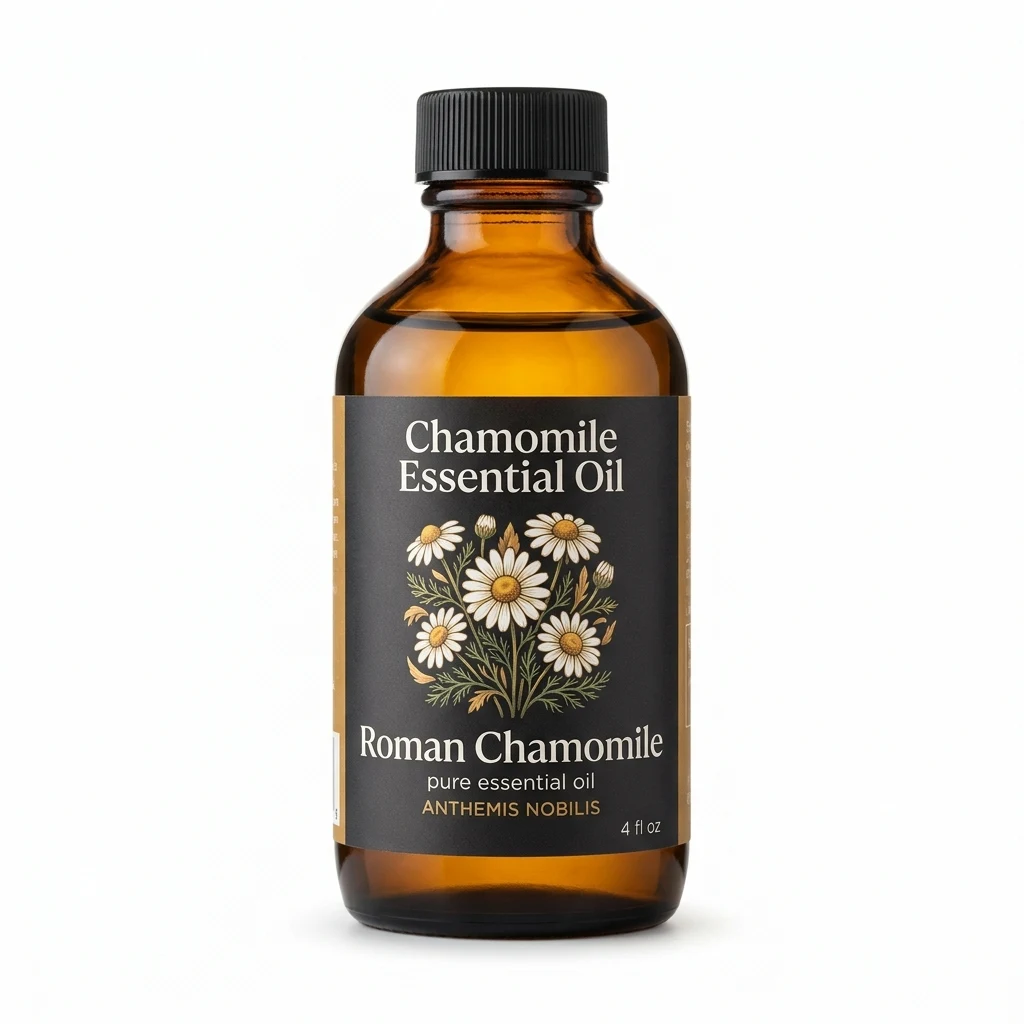
Roman Chamomile Essential Oil
Our own Roman Chamomile Essential Oil, in sizes from 0.5 oz to bulk.
From $32.99
Shop Now →First decide which chamomile you are blending around
A comparison of the two plants' distilled oils, Tai et al., BMC Genomics, 2020, steam-distilled dried flower samples (three biological replicates per type) and reported relative peak areas, not percentages. German chamomile (Matricaria recutita) was dominated by sesquiterpenoids: alpha-bisabolol oxide A, chamazulene, alpha-bisabolol oxide B and alpha-bisabolol. Against Roman chamomile (Chamaemelum nobile), the oxide A peak was about 50 times larger, oxide B about 30 times and chamazulene about 10 times. The Roman samples were dominated by esters, with a smaller sesquiterpene fraction. This was a plant-biology paper with its own distillation method, so it says nothing about any particular bottle, ours included.
Our product pages describe the Roman oil as sweet, apple-like and herbaceous, and the German oil as deep blue from chamazulene. Reasoning from the paper plus those descriptions: the Roman oil's character is an ester character, and the German oil's is a heavier sesquiterpene one, with a colour you can see. That gives a working rule for the chart below. Pair Roman with partners that sit alongside a fruity, light note. Pair German with partners that have enough body to stand next to it. The note remarks in the chart are our reasoning, not the result of a sniff panel; we have not run one.
The pairing chart
Our product pages list lavender, bergamot, clary sage, geranium and sweet orange as blends, and ylang ylang for the German oil. We sell none of those partners, only the two chamomiles, so buy them from any reputable supplier. Our pages also class chamomile as a perfumery middle note, which is why partners are described as running alongside it rather than opening or anchoring a blend.
| Partner | Scent family | Fits which chamomile, and why (reasoning) | Watch for |
|---|---|---|---|
| Lavender | Herbal-floral | Either. A shared herbaceous edge, so neither oil is overpowered. | One more oil to patch test; see the sensitisation section. |
| Geranium | Floral | Roman. A rosy middle note sits beside apple-like esters without covering them. | Count drops, do not judge by smell. |
| Ylang ylang | Floral | German, per our product page. A heavy sweet floral has the body to stand next to the sesquiterpene-rich oil. | Easy to overdose by smell; start at one drop. |
| Sweet orange | Citrus | Roman. Brightens a light ester note. | Expressed vs distilled: see the bergamot section. |
| Bergamot | Citrus | Either, in small amounts. | Phototoxicity if expressed and not furanocoumarin-free. |
| Clary sage | Herbal | German. An herbal body note that lines up with hay-like depth. | Pregnancy: ask first, see below. |
For finished recipes with these partners, we already have three: lavender with chamomile, five diffuser blends, and the linen spray. This page is the logic behind picking, not another recipe.
Bergamot: the one partner that can hurt you in sunlight
A review of citrus oils (Dosoky and Setzer, International Journal of Molecular Sciences, 2018) states that distilled citrus oils are not phototoxic while expressed oils carry a low to moderate risk, because of furanocoumarins. It reports that expressed bergamot caused severe phototoxic effects in hairless mice and pigs under simulated sunlight, that chronic pigmentation (berloque dermatitis) and burns are the human skin effects described, and that no hazards were found for furanocoumarin-free (FCF) or rectified bergamot. Its Table 2 gives bergapten, the main furanocoumarin, at 0.11% to 0.33% of expressed bergamot against 0% to 0.0091% in FCF bergamot. Its Table 4 lists a 0.4% maximum dermal use level for FCF bergamot and no maximum for the expressed oil.
Worked through: a 30 ml bottle at 1% total oil holds 6 drops. If a third of that, 2 drops, is expressed bergamot, bergamot is 0.33% of the finished oil. At the review's bergapten range that is roughly 0.0004% to 0.0011% bergapten on your skin. We could not open the IFRA standard text, so we do not state a pass or fail against it. The practical consequence we draw is simpler: for anything that stays on skin and goes outdoors, use a bottle labelled furanocoumarin-free, or leave bergamot out. The same expressed-versus-distilled question applies to sweet orange, and the review's general rule is the thing to check on the label. In a room diffuser the skin issue does not arise.
Clary sage and pregnancy: what exists
The only trial we found on clary sage in pregnancy is a feasibility pilot, Tadokoro et al., BMC Research Notes, 2017: 11 women at 38 to 40 weeks, 5 inhaling the scent and 6 controls, allocated by order rather than randomly. It measured salivary oxytocin and found no significant differences. No uterine contractions were observed, and the authors reported no negative effects. They also said the numbers were too small and the design too loose to conclude much. A pilot of 11 women cannot establish that a blend is fine for anyone. The Tisserand Institute safety guidelines advise pregnant people to seek the advice of a doctor or suitable practitioner before using essential oils. So: if you are pregnant, ask your OB-GYN or midwife before blending with clary sage, or with anything else here.
Sensitisation: every oil you add is another thing to react to
Chamomile has its own record. In the review by Ključevšek and Kreft, Health Science Reports, 2025, 8 of 12 chamomile-sensitive patients reacted to topical chamomile products in which chemical analysis found no sesquiterpene lactones, so the cause was unclear. Reasoning from that: when a blend of four oils causes a rash, you cannot tell which oil did it. Patch test the finished blend, not the single oils, and keep skin blends to two or three oils. Our patch test guide covers the method; our safety article covers the allergy background. For a head-to-head against other oils rather than blends, see chamomile versus other essential oils.
Ratio arithmetic for a blend
The Tisserand Institute dilution page gives 0.5% to 1.2% for face and sensitive areas and 1% to 3% for body oils; our own pages say 0.5% to 2%. The percentage applies to all oils together, not to each one. Take 20 drops per ml (a convention that reproduces the 3 to 12 drops per ounce on our German page) and a 30 ml bottle at 1%: 6 drops in total. A 2:1 chamomile-to-partner split is 4 chamomile and 2 partner. A 1:1 split is 3 and 3. If you built each oil to 1% separately you would end at 2% or 3%, above the face range. Smell is a poor guide to dose, because the heavy florals dominate quickly, so begin with the chamomile as the larger share and add the partner one drop at a time.
If you are blending for a scent and not for skin, our two chamomile oils are both sold undiluted, and the dilution on your skin is a separate step you control. Pick the chamomile from the chart first, then choose partners that suit it.
Roman Chamomile Essential Oil
Roman Chamomile Essential Oil from our own shop, in sizes from 0.5 oz to bulk.
From $32.99
Shop Now →Sources & Further Reading
- Tai Y et al., 2020. Phytochemical and comparative transcriptome analyses of Matricaria recutita and Chamaemelum nobile. pmc.ncbi.nlm.nih.gov/PMC7029581
- Dosoky NS, Setzer WN, 2018. Biological Activities and Safety of Citrus spp. Essential Oils. pmc.ncbi.nlm.nih.gov/PMC6073409
- Tadokoro Y et al., 2017. Feasibility pilot on clary sage scent inhalation in term-pregnant women. pmc.ncbi.nlm.nih.gov/PMC5721455
- Ključevšek T, Kreft S, 2025. Allergic Potential of Medicinal Plants From the Asteraceae Family. pmc.ncbi.nlm.nih.gov/PMC11847717
- Tisserand Institute. Essential oil dilution guidance. tisserandinstitute.org/safety/dilution
- Tisserand Institute. Safety guidelines. tisserandinstitute.org/safety-guidelines