German Chamomile vs Blue Tansy: Same Blue, Different Oil
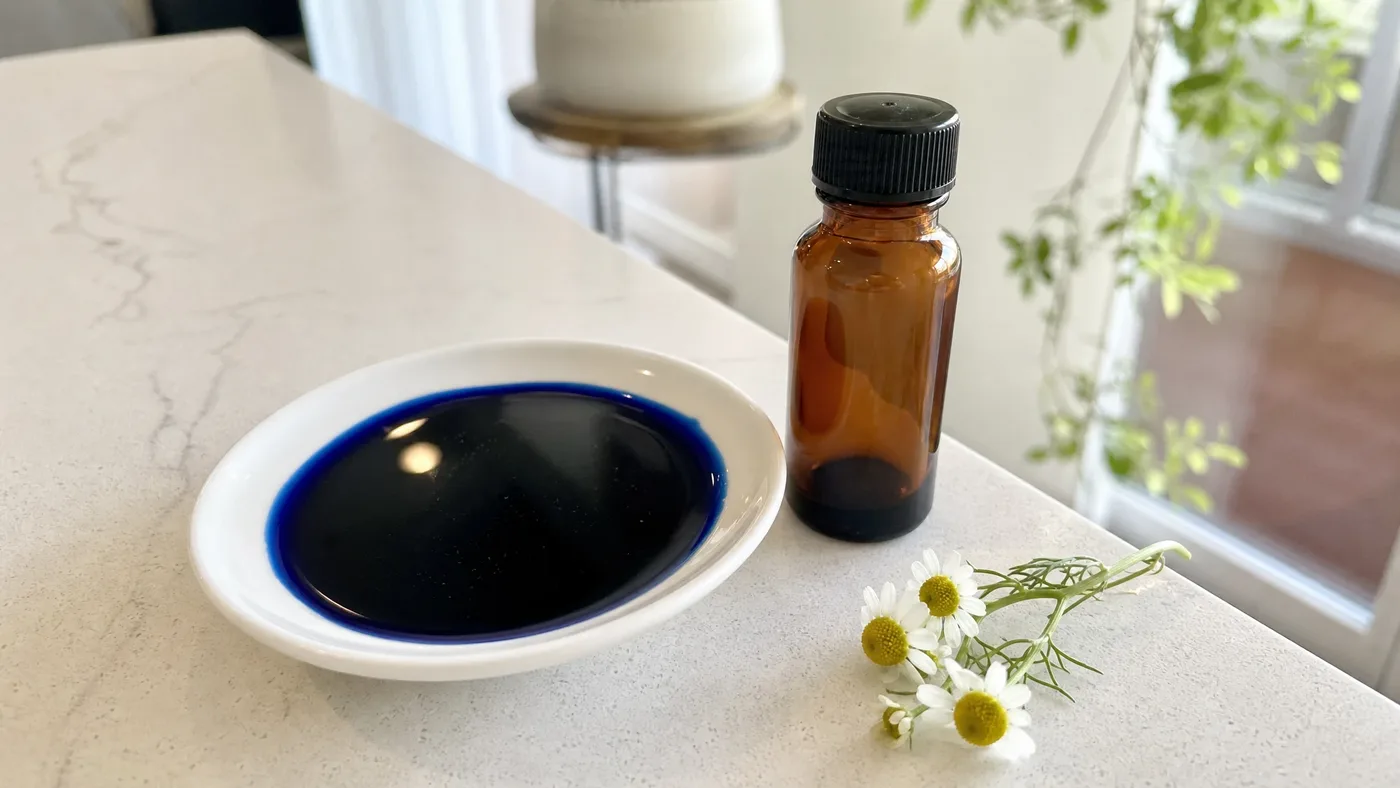
Blue tansy and German chamomile are both deep blue oils, and the colour comes from the same molecule, chamazulene. That is exactly why colour cannot tell you which bottle you are holding. They are different plants with different chemistry, and the difference matters if you plan to put either on skin. We sell the German chamomile oil and not blue tansy, so read this as a buyer's guide to telling them apart rather than a pitch.
Roman Chamomile Essential Oil
Our own Roman Chamomile Essential Oil, in sizes from 0.5 oz to bulk.
From $32.99
Shop Now →Start with the Latin name, not the colour
Blue tansy is Tanacetum annuum. German chamomile is Matricaria chamomilla (also written M. recutita). A label that says only "blue chamomile" or "chamomile blue" does not settle which plant is inside, and searches for blue tansy turn up listings with chamomile wording in the title. Reasoning from that, the Latin binomial and a lab report are the only checks that carry information. For why chamazulene turns distilled oil blue, see why blue chamomile oil is blue; we will not repeat the mechanism here.
Our own colour note points the same way: our "Inside the Still" page says German chamomile's colour is made in distillation, and warns that the oil will stain pale fabric. A stain test on cloth would not separate the two oils either, since both carry the same pigment (my reasoning, not something we have tried).
What the lab numbers say, one sample each
We found one peer-reviewed analysis of blue tansy oil that we could read in full, and one of German chamomile oil. Each is a single sample, so treat the numbers as examples, not standards.
| Constituent | Blue tansy oil (Ettakifi et al., 2023) | German chamomile oil (Yilmaz et al., 2025) |
|---|---|---|
| Camphor | 16.69% | not among the major constituents listed in the abstract |
| alpha-Pinene | 12.37% | not reported |
| Bornyl acetate | 11.97% | not reported |
| Limonene | 11.10% | not reported |
| Chamazulene | 3.49% | named a major constituent, no percentage in the abstract |
| (Z)-beta-farnesene | not reported | 33.90% |
| alpha-Bisabolol oxide B | not reported | 11.60% |
The blue tansy figures come from Ettakifi et al., Antibiotics, 2023: aerial parts collected July to September 2020 near Tetouan in northwestern Morocco, hydrodistilled for 3 hours, 39 compounds identified. The paper was about antifungal activity against a date palm pathogen, not about cosmetics, and was funded by a Moroccan research project. The German chamomile figures come from Yilmaz et al., Zeitschrift fur Naturforschung C, 2025, a GC-MS analysis paired with cytotoxicity testing. We read only the abstract of that one, which is why the table has blanks.
Two things stand out. First, the sample of blue tansy held only 3.49% chamazulene, so "blue" does not mean "mostly chamazulene". Second, other published analyses of blue tansy report different proportions, and commercial lots clearly vary with origin and season; we could not read those papers, so we cite none. Whatever one lab found in one batch, it is a profile to compare against, not a rule.
Why the camphor line matters
Blue tansy's profile in that sample is monoterpene-heavy, with camphor leading. German chamomile's headline constituents are a sesquiterpene (farnesene), bisabolol oxides and chamazulene. Different chemistry means different skin and safety questions, and a swap on colour alone swaps those questions too.
Here is the arithmetic for one example. If an oil contains 16.69% camphor, a 2% dilution (our German page's upper range) delivers 0.02 x 0.1669 = 0.33% camphor in the finished blend; at 5% dilution that is 0.83%. Those figures apply to that one sample only. We could not retrieve a Tisserand dermal limit for blue tansy, so we give none and we will not guess one. Camphor is a recognised neurotoxic hazard at high exposures: a 2023 Cureus case report described a man who drank roughly 500 mL of liquid camphor oil and had tonic-clonic seizures. That was a different product, swallowed, at a vastly higher dose than any skin use, so it says nothing about a diluted cosmetic blend. What it explains is why sellers flag camphor for children, people with epilepsy and pregnancy. Those are questions for a physician or pharmacist, not for a product page.
How to tell which one you have
- Read the label for the Latin name. Tanacetum annuum is blue tansy; Matricaria chamomilla or recutita is German chamomile. No Latin name, no purchase.
- Ask for the lab report for the batch. A GC-MS table that leads with camphor, pinene and bornyl acetate looks like the tansy sample above; one that leads with farnesene and bisabolol oxides looks like the chamomile sample. Compare profiles, not a single colour.
- Check the lot or batch number on the bottle matches the report.
Our German chamomile oil's product page carries a Certificate of Analysis you can read before buying. For the Roman oil, the page tells buyers to contact us about documentation. For blue tansy, you will need to ask whoever sells it; we do not carry it. Our guide to reading a GC-MS report goes line by line.
The allergy overlap
Both plants belong to the Compositae (Asteraceae) family. In Jovanovic et al., Medicinski pregled, 2004, 30 adults with atopic dermatitis were patch tested with a Compositae mix and extracts of arnica, chamomile, tansy, feverfew and yarrow. Nine were sensitised, and chamomile was the most frequent single positive (5 of the 9). That used plant extracts, not essential oils, and the "tansy" extract was not specified as blue tansy, so reading it onto either oil is an inference. The practical point stands: if you are allergic to ragweed or daisy-family plants, do not treat the two as interchangeable or as stand-ins for each other; see an allergist or dermatologist.
Who should pick which
If you go with the German oil, remember it arrives undiluted, so the dilution is your job. Taking 1 oz as 29.57 ml and 20 drops per ml (an approximation), an ounce of carrier holds about 591 drops, so 3 drops is about 0.5%, 6 drops about 1% and 12 drops about 2%, which is how our page's 3 to 12 drops per ounce maps onto its 0.5% to 2% range. We have not tested any recipe built this way, so patch test before you use it more widely.
- You want a blue chamomile oil and have no Asteraceae allergy: German chamomile, diluted to our page's 0.5% to 2% range, patch tested first. Our German chamomile profile covers the oil itself.
- You want blue tansy specifically: buy it from a supplier that gives the Latin name and a lab report, and ask a pharmacist or physician about camphor if you are pregnant, nursing, have epilepsy, or are buying for a child.
- You were told "Moroccan chamomile" and are not sure which plant that means: see Moroccan chamomile oil, and check the Latin name before anything else.
The short version: the pigment is shared, the oils are not, and a bottle that cannot show you its Latin name and a lab report has not told you what is in it. For how these two sit among other options, see chamomile versus other essential oils.
Roman Chamomile Essential Oil
Roman Chamomile Essential Oil from our own shop, in sizes from 0.5 oz to bulk.
From $32.99
Shop Now →Sources & Further Reading
- Ettakifi H et al., 2023. Chemical characterization and antifungal activity of blue tansy (Tanacetum annuum) essential oil and crude extracts against Fusarium oxysporum f. sp. albedinis. Antibiotics (Basel). pmc.ncbi.nlm.nih.gov/PMC10526058
- Yilmaz S et al., 2025. GC-MS analysis and cytotoxicity of Matricaria recutita essential oil. Z Naturforsch C. pubmed.ncbi.nlm.nih.gov/40966193
- Jovanovic M et al., 2004. Contact allergy to Compositae plants in patients with atopic dermatitis. Med Pregl. pubmed.ncbi.nlm.nih.gov/15503788
- Jabbour SG et al., 2023. Case report: camphor oil ingestion with seizures. Cureus. pubmed.ncbi.nlm.nih.gov/38022187