Chamomile Oil for Anxiety and Stress: Trial by Trial
The chamomile studies that get quoted for anxiety, including the two best known randomized trials, tested capsules of oral extract, not essential oil. The essential-oil trials are a different and smaller set, mostly run in hospitals, and they measured different things. This page goes through both sets one trial at a time, says what each did and did not show, and is blunt about what a bottle of oil can and cannot be asked to do.
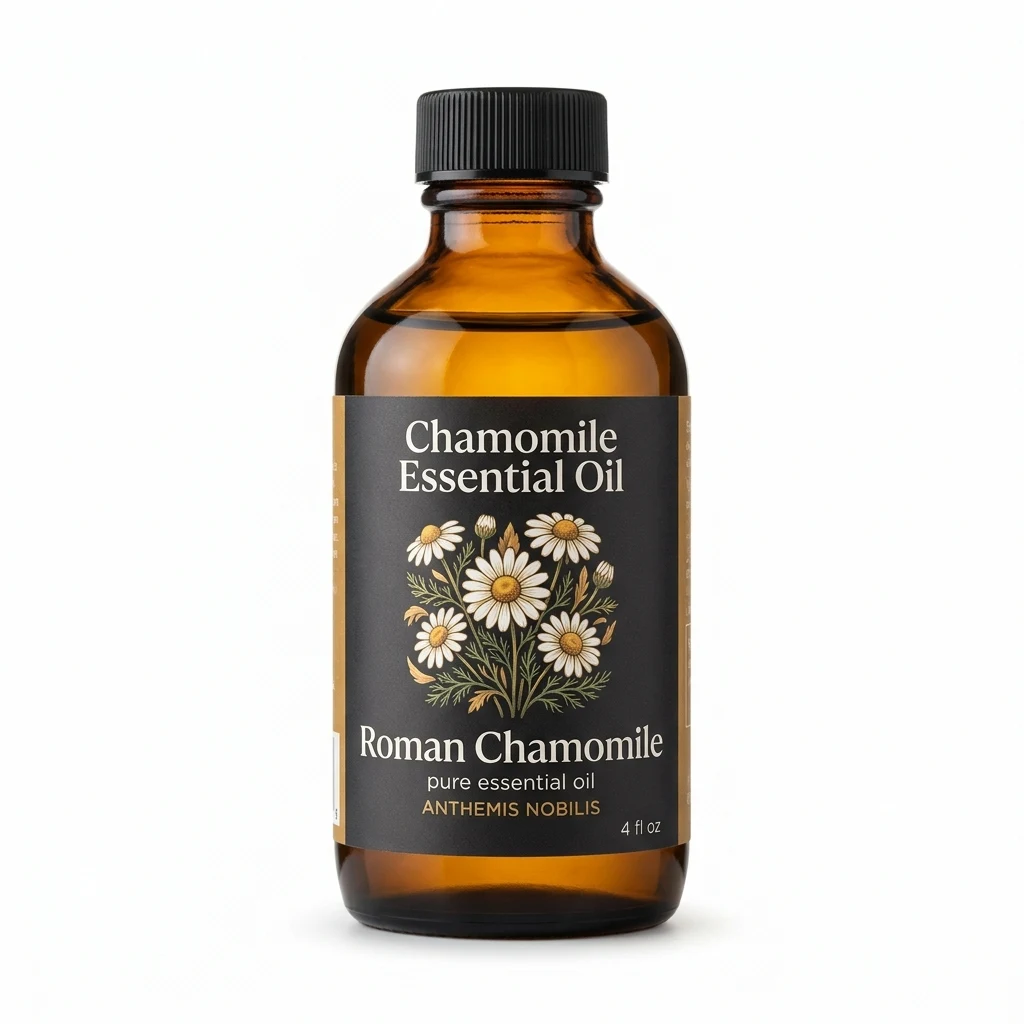
Roman Chamomile Essential Oil
Our own Roman Chamomile Essential Oil, in sizes from 0.5 oz to bulk.
From $32.99
Shop Now →Step one: which kind of study is it?
Before reading any headline, check the form. Amsterdam et al. (Journal of Clinical Psychopharmacology, 2009) randomized 57 outpatients with mild to moderate generalized anxiety disorder to oral Matricaria recutita extract or placebo for 8 weeks. The chamomile group had a larger fall in the Hamilton Anxiety Rating Scale (HAM-A; P = 0.047), and the study was not powered for its secondary measures. Mao et al., Phytomedicine, 2016 gave 1,500 mg a day of extract to responders, then randomized 93 of them to continue or switch to placebo for 26 weeks. Relapse was 15.2% on chamomile and 25.5% on placebo, but the hazard ratio of 0.52 had a confidence interval of 0.20 to 1.33 (P = 0.16), so the main comparison was not significant. A 2019 meta-analysis (Hieu et al., Phytotherapy Research) found HAM-A improvement at 2 and 4 weeks, but three trials of state anxiety showed no significant difference. All of this is swallowed extract. Nothing in it tells you what a scent does.
The inhaled-oil trials, one by one
- Acute coronary syndrome, Iran, 2024. Pourshaikhian et al., BMC Complementary Medicine and Therapies: 154 patients, double-blind, 10% Matricaria chamomilla oil (7 drops inhaled on two consecutive nights) against sesame oil on cotton. On a six-item Spielberger state anxiety scale, scores fell 5.2 points with chamomile and 1 point with placebo. Heart rate and blood pressure were also lower (P < 0.001 for anxiety). Funding was not stated in the record we read.
- Community-dwelling older adults, Iran, 2022. Ebrahimi et al., Explore: 183 people, 61 per arm (lavender, chamomile, control). Three drops of 1.5% chamomile oil inhaled nightly for 30 nights; the control inhaled distilled water. Depression, anxiety and stress scores (DASS) were lower than control straight after and at one month (P < 0.01). The abstract gives no effect sizes, and distilled water has no smell, so participants could tell which arm they were in.
- Pre-operative orthopedic patients, Iran, 2024. Bahrami et al., Journal of Perianesthesia Nursing: 90 patients across damask rose, chamomile and control. Both oils improved visual-analog anxiety scores over time versus control (P < .001), but damask rose gave lower anxiety than chamomile right after (P = .01), and the gap was not significant at one hour (P = .07). The abstract reports 40% concentration, three drops hourly for three hours, and does not name the chamomile species.
- Children in dental pulp therapy, Egypt, 2025. Abdel Rehim et al., Journal of Dental Science: 100 children aged 6 to 9 in four groups, oil by nebulizer. On an emoji scale, anxiety changed by +0.04 in controls, -2.04 with chamomile and -1.80 with lavender (not significantly different from chamomile). Oxygen saturation did not differ (P = 0.78). This is a study in children, and we are not suggesting anything for a child; see a pediatrician or pediatric dentist.
- Nurses, Iran, 2020. Zamanifar et al., Journal of Medicine and Life: 120 nurses, Beck Anxiety Inventory after three shifts: 37.82 with a chamomile-lavender oil, 56.08 in controls. It was a blend, so the chamomile share cannot be separated.
The common pattern is that every arm containing an aroma reported lower scores than a no-aroma control. That is the pattern you would expect from an effect of the oil, and also the pattern you would expect from expectation, because smell is hard to blind. The one design that partly addresses this is Pourshaikhian's sesame-oil placebo, but sesame still smells like something. Reasoning from that, the defensible reading is "a scent that people expect to be calming was associated with lower self-rated anxiety in these settings," not "the oil lowers anxiety."
Why the scores cannot be lined up
Each trial used a different instrument: the HAM-A is a clinician-rated interview, the Spielberger scale, DASS and Beck inventory are self-report questionnaires, and the dental trial used a picture scale for children. A 5.2-point fall on a six-item scale and a 2-point fall on an emoji scale are not the same size of change, so no ranking of "which study worked best" is possible from the abstracts. A 2026 scoping review (Cabral et al., Complementary Therapies in Medicine) counted 17 hospital studies of chamomile aromatherapy, reported anxiety reductions in 58.8% of them, and found German chamomile (Matricaria chamomilla) the most cited species. That counts papers rather than weighing them, and we saw only its abstract.
The dose arithmetic nobody prints
These concentrations look wildly different, so here is the ordinary maths, assuming about 20 drops per ml (dropper-dependent, so treat the results as approximate). Reasoning, not a trial finding.
- Ebrahimi: 3 drops of a 1.5% solution is about 0.15 ml of liquid, containing about 0.002 ml of oil, roughly a tenth of a drop of neat oil per night.
- Pourshaikhian: 7 drops of 10% is about 0.35 ml, containing about 0.035 ml of oil, roughly 0.7 of a neat drop.
- Bahrami: 9 drops of 40% over three hours is about 0.45 ml, containing about 0.18 ml of oil, roughly 3.6 neat drops.
Those are inhalation figures from different carriers and delivery methods, and the spread is almost 100-fold. Our oils are sold undiluted, with a stated skin range of 0.5% to 2% in a carrier, so dilution is yours to calculate. Do not take the trial concentrations as skin dilutions, and do not treat any of them as a recommended dose.
What this does not cover, and who to see
An anxiety disorder is a medical condition. If worry is interfering with work, sleep or relationships, or lasting weeks, see a physician, psychologist or psychiatrist. The extract trials above were in people with generalized anxiety disorder under clinical supervision, which is not a model for self-directed use. A bottle of essential oil is not a replacement for care, and a scent is not what those trials tested.
If you are in crisis or thinking about harming yourself, call or text 988 in the United States, or chat at 988lifeline.org. The 988 Lifeline states it is available 24 hours a day, every day.
On the oil side, skip it if you react to ragweed, daisies or related plants (NCCIH, 2024), keep it away from children and pets, and never swallow it. Our broader benefits evidence map places these trials among the others, the wind-down routine covers evening use as a habit, and the lavender and chamomile post covers the blend. If you simply want the smell of chamomile as part of a calm evening, either of our two oils does that, and that is all we say about it.
Roman Chamomile Essential Oil
Roman Chamomile Essential Oil from our own shop, in sizes from 0.5 oz to bulk.
From $32.99
Shop Now →Sources & Further Reading
- Amsterdam et al., 2009. Oral chamomile extract for generalized anxiety disorder. PMID 19593179
- Mao et al., 2016. Long-term chamomile treatment for generalized anxiety disorder. PMID 27912875
- Hieu et al., 2019. Chamomile for state anxiety, GAD, insomnia and sleep quality. PMID 31006899
- Pourshaikhian et al., 2024. Chamomile aromatherapy in acute coronary syndrome. PMID 38172912
- Ebrahimi et al., 2022. Lavender and chamomile inhalation in older adults. PMID 33454232
- Bahrami et al., 2024. Damask rose and chamomile aromatherapy before orthopedic surgery. PMID 38300194
- Abdel Rehim et al., 2025. Inhalation aromatherapy for dental anxiety in children. PMID 40654405
- Cabral et al., 2026. Chamomile aromatherapy for pain and anxiety in hospitals: scoping review. PMID 42031027
- Zamanifar et al., 2020. Music therapy and chamomile-lavender aromatherapy in nurses. PMID 32341707
- NCCIH, 2024. Chamomile. nccih.nih.gov/health/chamomile
- 988 Suicide & Crisis Lifeline. 988lifeline.org