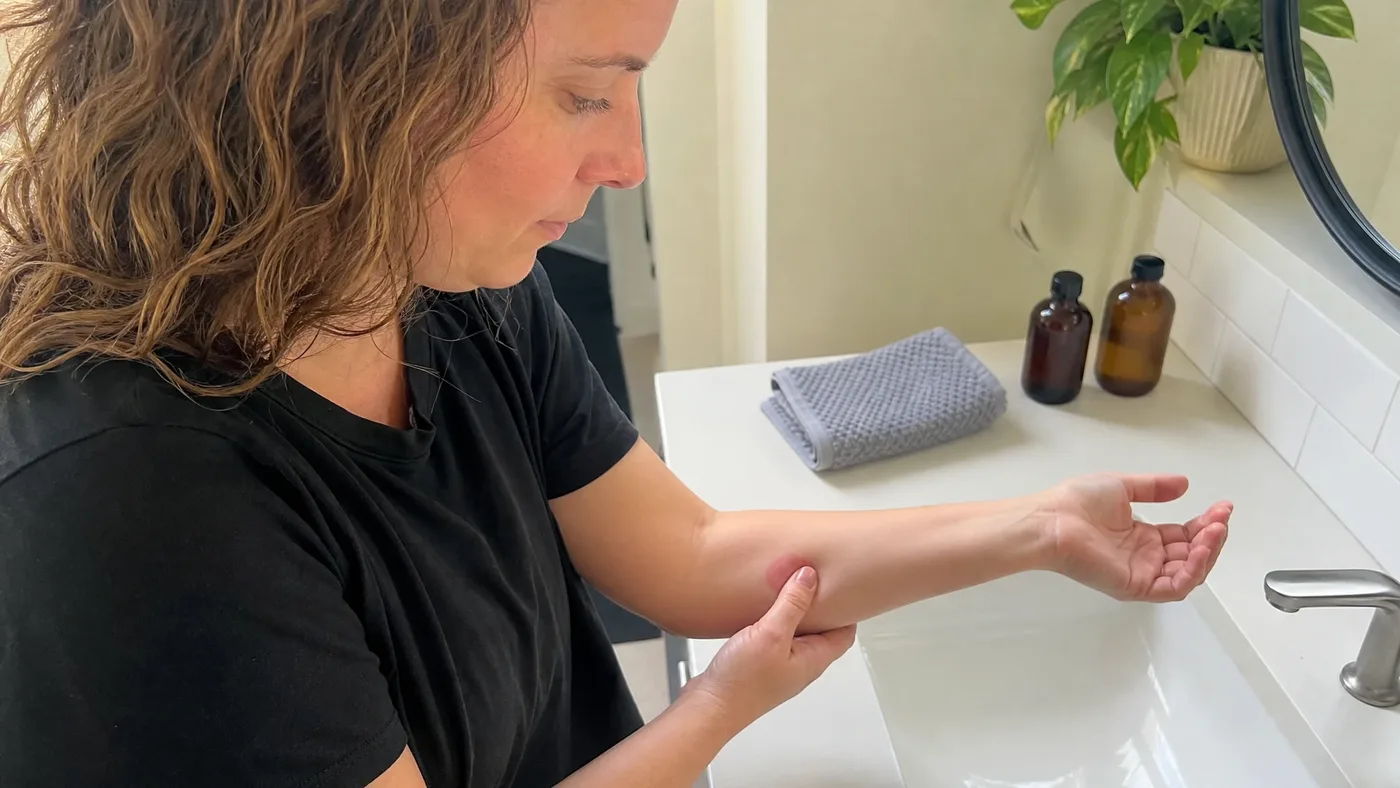
Chamomile Oil Side Effects and Drug Interactions, by Evidence
Most of the chamomile interaction warnings you will find were written about tea, extract capsules or lotion, not a few drops of essential oil in a carrier. That does not make the warnings meaningless, but it changes what they tell you. Below, the reaction types come first, then the interactions, with what each study did and what it did not. The oils we sell are German and Roman chamomile, undiluted, so where evidence is thin we say so and point to the pharmacist.
Roman Chamomile Essential Oil
Our own Roman Chamomile Essential Oil, in sizes from 0.5 oz to bulk.
From $32.99
Shop Now →Reaction types, from most to least documented
| Type | What was reported | What it was |
|---|---|---|
| Skin allergy (contact dermatitis) | Case reports of eczema after compresses, ointments and tea washes; sensitised patients positive on patch tests | Roman and German chamomile preparations, mostly not essential oil |
| Immediate allergy (anaphylaxis) | Case reports after tea and after tea or chamomile enemas | Oral or mucosal, not skin |
| Inhalation reaction | One report of head rush, tachycardia and nausea | Roman chamomile oil on a smelling strip |
| Eye irritation | Listed by NCCIH | Chamomile used near the eyes |
| Drug interaction | One warfarin case report, in-vitro enzyme data | Tea and lotion; isolated enzymes |
Skin: delayed and immediate are different problems
The European Medicines Agency draft assessments hold most of the case reports. In the Roman chamomile draft (EMA/HMPC/560906/2010, draft, 2011), sensitisation followed compresses of Roman chamomile in patients in Belgium and Portugal, and a French patient reacted after compresses plus a homeopathic preparation containing Roman chamomile oil. The assessors judged the allergy to be "primarily" caused by sesquiterpene lactones, but note that three of five patients also had weak reactions to fragrance allergens and two to balsam of Peru, and they call that link "hypothetic."
The German draft (EMA/HMPC/55837/2011) lists a 50-year-old metalworker who developed acute eczema on hands and forearms after tea washes, positive to Roman chamomile extract at 1% in petrolatum at patch-test readings on days 2 and 4, and a woman whose recurring facial eczema followed steaming chamomile tea. Two things follow. Delayed reactions can appear days after contact, so a five-minute check is not a patch test (our guide). And steam or airborne exposure triggered a reaction in at least one person.
Which species? DermNet names nobilin (Roman) and desacetylmatricarin (German) as the allergens, both sesquiterpenes, and describes a six-year German study in which 67 patients were found allergic to chamomile. Neither source ranks one species as milder, so we do not.
The wider literature agrees on mechanism: a 2025 review of Asteraceae plants used in herbal products says sesquiterpene lactones can sensitise the skin and, in sensitised people, provoke systemic reactions on ingestion, while pollen allergens drive the ragweed and mugwort cross-reactions (Ključevšek and Kreft, 2025). A 2024 allergist-facing review notes that some weed-pollen allergic patients react to chamomile herbal products (Preda et al., 2024). Both are reviews, not trials of the oil.
Immediate reactions: be careful what the reports are about
Every anaphylaxis report in the German draft involves tea or a chamomile enema: an 8-year-old boy with pollen allergy after a cup of tea, a ragweed-allergic woman after several sips, a man after a tea enema, and a woman in labour after an enema containing a chamomile preparation. The assessors describe the enema reaction as "not a pregnancy related risk but could happen to any atopic patient reacting to asteraceae." We found no anaphylaxis report for diluted essential oil on intact skin. That is an absence in what we found, not proof it cannot happen.
The one inhalation report in the Roman draft is a nursing student who developed head rush, tachycardia and nausea after Roman chamomile oil was dropped on a smelling strip in a class exercise; the author, who taught for ten years, described it as the only such reaction she had seen (Maddocks-Jennings, 2004, as cited by the EMA).
Interactions: what each source actually tested
- Warfarin. Segal and Pilote described a 70-year-old woman with a mechanical mitral valve on warfarin whose INR went from 3.6 to 7.9 with a large pelvic haematoma after "simultaneous and excessive" use of chamomile tea and chamomile lotion. The authors considered a pharmacodynamic interaction "highly likely" and noted no earlier case, so it is one patient, with the causal link resting on excluding other explanations (CMAJ, 2006). The EMA assessors disagreed with using it: they called the coumarin explanation "not probable" because many herbs carry inert coumarins.
- A trial that tested the idea. In a randomised crossover trial of 12 healthy volunteers, seven days of chamomile tea (9 bags a day) or extract capsules did not change prothrombin time compared with placebo (tea -0.2 +/- 0.4 s, extract -0.2 +/- 0.4 s, placebo 0.1 +/- 0.5 s; p = 0.34) (Schwartz et al., 2023). The volunteers were not taking warfarin, and the product was tea and extract, not oil.
- Liver enzymes. In vitro, German chamomile essential oil inhibited four human cytochrome P450 enzymes, CYP1A2 the most; chamazulene, one of the compounds that colour German oil blue, had an IC50 of 4.41 micromolar against it (Ganzera et al., Life Sciences, 2006). The authors say interactions with drugs cleared mainly through these enzymes are "possible." This used isolated enzymes, not people.
- Other drugs. NCCIH lists interactions reported with some liver-metabolised drugs and warfarin, calls a sedative interaction theoretical, and says preliminary studies suggest chamomile might reduce the effect of birth control pills (NCCIH). The EMA German draft also includes two transplant patients whose cyclosporine levels moved with large amounts of herbal tea, and added a note for patients after renal transplants taking high doses for about two months.
What this means for a few drops on skin
Reasoning from the sources above, with no human study of dilute chamomile oil to lean on: the warfarin and cyclosporine reports involved tea or lotion in large, repeated amounts, so they do not show that a diluted oil applied to a small patch of skin interacts with anything. Equally, nobody has shown it does not. The enzyme data come from the oil itself, which is why we do not wave the question away. What we can say is that the sensible dose of caution rises with the number of regular medicines and with how narrow the margin is on any one of them. For warfarin or a transplant medicine, that is a pharmacist's decision, not ours.
What to bring to the pharmacist
- The species (German, Roman) and that it is an undiluted essential oil, not tea.
- Your intended dilution (our pages say 0.5% to 2%) and where on the body, how often.
- Your full medicine and supplement list, especially warfarin or other blood thinners, birth control, sedatives, and transplant drugs.
- Any daisy-family or ragweed allergy, or past reactions to chamomile products.
See our safety overview for the wider decision, why we advise against swallowing it and pregnancy.
Who should skip it
Skip our oils with a known chamomile or daisy-family allergy, or if you take warfarin or a transplant drug and your pharmacist has not cleared it. We sell oil, not advice, and we have no data on how any customer reacted.
Roman Chamomile Essential Oil
Roman Chamomile Essential Oil from our own shop, in sizes from 0.5 oz to bulk.
From $32.99
Shop Now →Sources & Further Reading
- EMA HMPC, 2011 (draft). Assessment report on Chamaemelum nobile (L.) All., flos. ema.europa.eu, EMA/HMPC/560906/2010
- EMA HMPC, 2014 (draft). Assessment report on Matricaria recutita L., flos and aetheroleum. ema.europa.eu, EMA/HMPC/55837/2011
- Segal R, Pilote L, 2006. Warfarin interaction with Matricaria chamomilla. CMAJ 174(9):1281-1282. pmc.ncbi.nlm.nih.gov/PMC1435958
- Schwartz JA et al., 2023. Effect of chamomile intake on blood coagulation tests in healthy volunteers. pubmed.ncbi.nlm.nih.gov/37730613
- Ganzera M, Schneider P, Stuppner H, 2006. Inhibitory effects of the essential oil of chamomile on human cytochrome P450 enzymes. Life Sci. pubmed.ncbi.nlm.nih.gov/16137701
- Ključevšek T, Kreft S, 2025. Allergic potential of medicinal plants from the Asteraceae family. pubmed.ncbi.nlm.nih.gov/39995792
- Preda M, Smolinska S, Popescu FD, 2024. Diagnostic workup in IgE-mediated allergy to Asteraceae weed pollen and herbal medicine products in Europe. pubmed.ncbi.nlm.nih.gov/39336535
- NCCIH. Chamomile. nccih.nih.gov/health/chamomile
- DermNet. Chamomile. dermnetnz.org/topics/chamomile