Can You Swallow Chamomile Essential Oil? The Numbers Say No
No. Do not swallow chamomile essential oil, ours or anyone's. "Internal use" advice online usually leans on one true fact, that chamomile tea is a common drink, and stretches it to a concentrated oil. This article shows the arithmetic that separates the two, what the US food rules actually list, and what to do if a bottle has already been swallowed. Our product pages say the same thing: not for internal use.
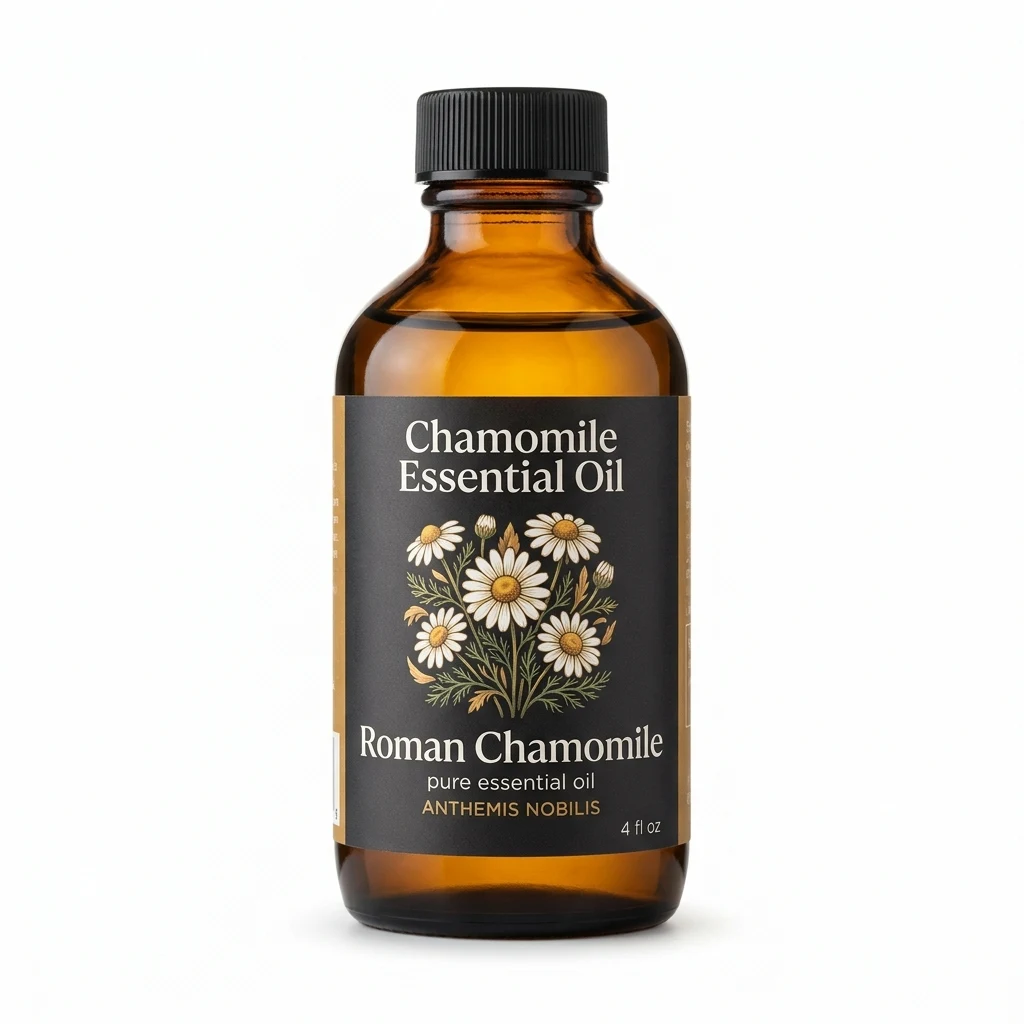
Roman Chamomile Essential Oil
Our own Roman Chamomile Essential Oil, in sizes from 0.5 oz to bulk.
From $32.99
Shop Now →If someone has swallowed it
Call Poison Control in the US at 1-800-222-1222, or use the online tool at poison.org. The service is free, confidential and open 24 hours (poison.org). If the person is unconscious, seizing or not breathing, call emergency services (911 in the US) instead. We have no chamomile-specific advice to add, and a product page is the wrong place to look first.
Tea versus oil: the worked numbers
The European Medicines Agency draft on German chamomile gives three figures we can use (EMA/HMPC/55837/2011, draft, 2014): the flowers contain essential oil at 0.3% to 1.9% (the Pharmacopoeia minimum yield is 0.4%); and teas brewed from the flowers contain 10% to 15% of the oil available in the flower.
Put those together for one gram of dried flowers. Oil in the flower: about 4 mg at the 0.4% minimum, up to 19 mg at 1.9%. Oil reaching the cup at 10% to 15%: roughly 0.4 to 0.6 mg at the low end, 1.9 to 2.9 mg at the high end. Now the bottle. One drop is about one-twentieth of a millilitre; assuming a density near 0.9 g/ml (our assumption, not a measured value for our oils), that is roughly 45 mg. Dividing, one drop holds about as much oil as the tea from 15 to 110 grams of flowers. That is tens of grams of flowers' worth of tea oil, delivered in one swallow, with nothing diluting it. A 0.5 oz bottle holds around 590 drops.
This is reasoning from a regulator's figures, labelled as such, and it ignores that tea carries other compounds. It does show why the safety record of a drink says little about a dropper bottle.
What the "GRAS" listing does and does not say
People cite the US food rules as proof that chamomile is fine to eat. The rules do list it. Title 21 of the Code of Federal Regulations, section 182.10, names camomile, English or Roman (Anthemis nobilis) and German or Hungarian (Matricaria chamomilla), in the list of spices and other natural seasonings and flavorings designated GRAS ("generally recognized as safe") under their intended conditions of use (eCFR, 21 CFR 182.10). Section 182.20, headed "Essential oils, oleoresins (solvent-free), and natural extractives (including distillates)," lists chamomile flowers, Hungarian and Roman (eCFR, 21 CFR 182.20).
The operative words are "for their intended use": flavouring in food, at the trace levels a flavourist adds. The regulation does not describe a bottle sold to a consumer, and it sets no dose for swallowing the concentrate. Our oils are sold for aroma and diluted skin use. We do not advise swallowing them, and we have not seen a source that supports doing so.
But is it not taken by mouth somewhere?
Yes, and the details matter. The EMA draft is an assessment of traditional herbal medicines, and it covers both the flowers and the essential oil. The oral preparations it lists are teas and liquid extracts, with dosing in millilitres of a diluted extract, and it records that one Belgian extract is not to be given to children under 12. The only essential oil entry we found in its list of established national uses is a bath additive, listed in Germany since 1976, at 0.12 to 0.5 g of oil per 100 g of additive, used as 10 to 20 ml in an 80 litre full bath. So the oil's one documented traditional use there is as a few millilitres of a diluted bath product, not a drink. NCCIH's page, for its part, concerns supplements and tea, and it says chamomile is "likely safe" in the amounts found in teas and foods (NCCIH's phrasing, about tea and food, not about essential oil; NCCIH).
What we found on harm, and what we did not
We found no case series of chamomile essential oil poisoning, so we cannot give you a toxic dose, and a missing number is not a reassuring one. Poison data for essential oils in general are clearer. In a review of 4,412 calls to the New South Wales Poisons Information Centre, 31% of callers had symptoms at the time of the call and 8.3% were referred to hospital; the authors note severe toxicity can follow as little as 5 mL (Lee, Harnett and Cairns, Med J Aust, 2020). Chamomile was not among the oils the report names. See our children's article for storage.
Two further reasons, offered as reasoning from fetched sources rather than as proof:
- Mucous membranes and allergy. The EMA draft records severe allergic reactions, including anaphylaxis, after mucosal contact with liquid chamomile preparations, in people sensitised to daisy-family plants. Those were tea and enema cases, but the mouth and throat are mucosal too.
- Drug metabolism. In a laboratory study using isolated human enzymes, German chamomile essential oil inhibited several cytochrome P450 enzymes, CYP1A2 most strongly (Ganzera et al., Life Sciences, 2006). That is not a human study, but it is a reason a pharmacist would want to know before concentrated oil meets a regular medicine. More on this in our side effects article.
Why there is no "how many drops" answer here
Pages that recommend a drop in water, honey or a capsule have to supply a dose, and that dose has to come from somewhere. We looked for one: no regulator, poison centre or review we fetched gives an oral dose for chamomile essential oil as a consumer product. A number on this page would therefore be invented, which our house rules forbid. A drop of oil in a glass of water also does not dissolve, so the first mouthful of that glass is the undiluted oil on the lining of the mouth and throat. That last point is our reasoning from how oil and water behave, not a finding from a study.
Wanting the tea instead
If what you want is the drink, buy tea; we do not sell it and we do not sell essential oil for that purpose. We cover the tea-versus-oil confusion in our myths article and the wider rules in our safety overview. If you take warfarin, other regular medicines, are pregnant, or have a daisy-family allergy, ask your pharmacist or physician about tea as well.
Who should skip it
Everyone, for swallowing. The skin-and-aroma use our pages describe is a different decision with its own limits.
Roman Chamomile Essential Oil
Roman Chamomile Essential Oil from our own shop, in sizes from 0.5 oz to bulk.
From $32.99
Shop Now →Sources & Further Reading
- NCCIH. Chamomile. nccih.nih.gov/health/chamomile
- Poison Control (AAPCC). Essential oils. poison.org/articles/essential-oils
- EMA HMPC, 2014 (draft). Assessment report on Matricaria recutita L., flos and aetheroleum. ema.europa.eu, EMA/HMPC/55837/2011
- US FDA, Code of Federal Regulations, 21 CFR 182.10. ecfr.gov, 21 CFR 182.10
- US FDA, Code of Federal Regulations, 21 CFR 182.20. ecfr.gov, 21 CFR 182.20
- Lee KAYR, Harnett JE, Cairns R, 2020. Essential oil exposures in Australia. Med J Aust. mja.com.au
- Ganzera M, Schneider P, Stuppner H, 2006. Inhibitory effects of the essential oil of chamomile and its major constituents on human cytochrome P450 enzymes. Life Sci. pubmed.ncbi.nlm.nih.gov/16137701