
Chamomile Oil for Digestion: The Evidence Is About Tea
Chamomile's reputation for the stomach was earned by a cup of tea, not by essential oil, and the two are not interchangeable. Steam-distilled oil is a concentrated volatile fraction of the flower, while tea and extracts are water or alcohol extractions swallowed in milligram amounts. We sell the oil, undiluted, for skin and scent use, and we do not recommend swallowing it. So the honest question is what, if anything, an oil on the abdomen adds, and the answer from the papers we read is: untested.
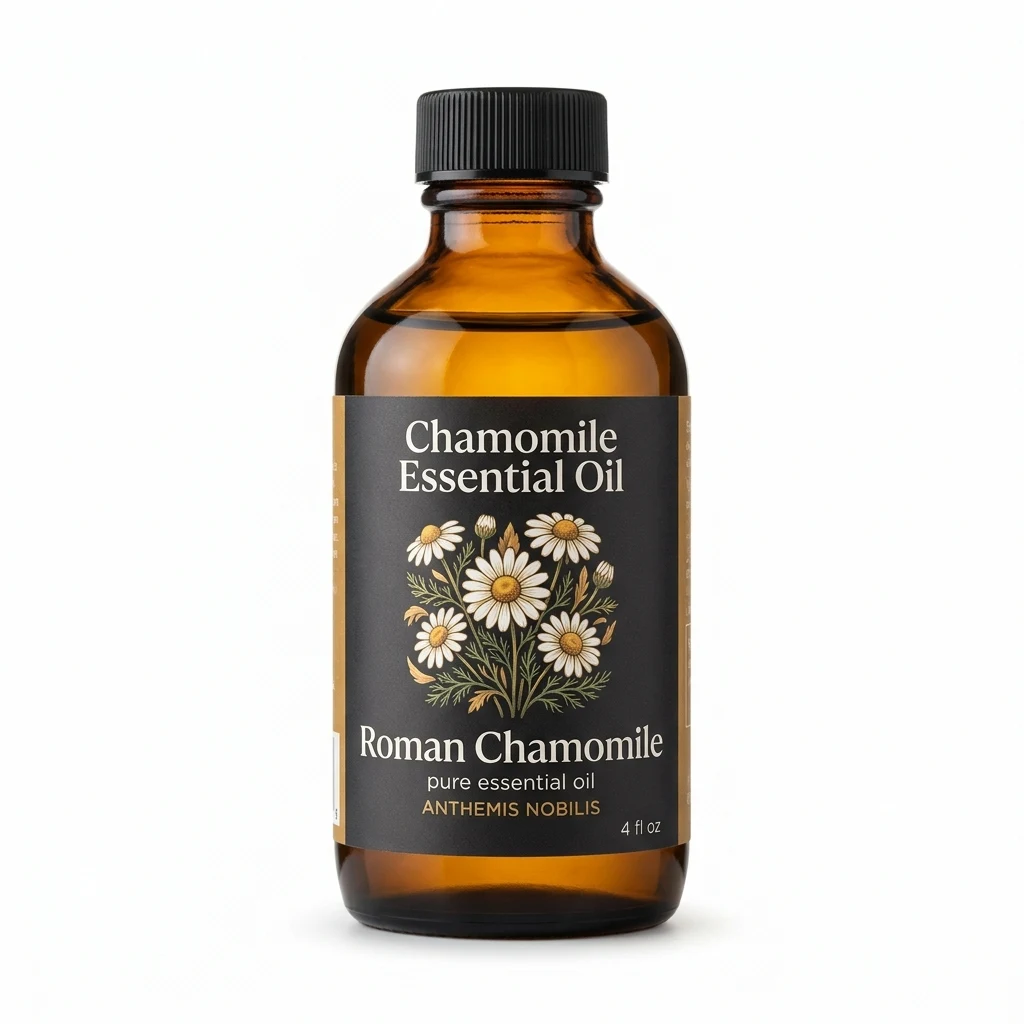
Roman Chamomile Essential Oil
Our own Roman Chamomile Essential Oil, in sizes from 0.5 oz to bulk.
From $32.99
Shop Now →Start with the red flags, before any oil
The NIDDK's constipation page lists signs that call for a doctor right away: rectal bleeding, blood in the stool, constant abdominal pain, being unable to pass gas, vomiting, fever, lower back pain, and weight loss you did not intend. It also says to see a doctor if symptoms do not go away with self-care, or if there is a family history of colon or rectal cancer (NIDDK, constipation: symptoms and causes). If any of those fit, the product question is moot and a physician is the right call. Those are the adult page's flags; for a baby or child with stomach trouble, the professional is a pediatrician.
What the digestive evidence is made of
- Tea and the NCCIH reading. The NCCIH chamomile page (updated November 2024) says products combining chamomile with other herbs may help diarrhea in children and colic in infants, but that "chamomile alone has not been shown to be helpful for these conditions." It does not mention the essential oil at all, which is the gap this whole page sits in.
- The EMA monograph. The EMA's Matricariae flos page lists, under traditional use, symptoms of minor gastrointestinal complaints such as bloating and minor spasms, via teas and oral liquids. "Traditional use" means plausible effect and at least 30 years of use, with clinical evidence judged insufficient. The oil is not stated to be covered.
- Multi-herb products. A pooled analysis of three placebo-controlled trials of STW 5 (Iberogast) for functional dyspepsia (Melzer et al., Alimentary Pharmacology & Therapeutics, 2004; 138 on the product, 135 on placebo) reported a better most-bothersome-symptom result (OR 0.22, 95% CI 0.11 to 0.47). A 60-person trial of the same family (Madisch et al., Zeitschrift fur Gastroenterologie, 2001) reported symptom scores improved over placebo at 2 and 4 weeks. STW 5 contains nine herbal extracts, chamomile being only one, and the Melzer record says the producer was consulted, so it says nothing about chamomile on its own, and nothing about oil.
- What guidelines favour. A systematic review of gastroenterology guidelines (Utz et al., Zeitschrift fur Gastroenterologie, 2024) reports that peppermint oil is strongly recommended for irritable bowel syndrome and psyllium for chronic constipation. The abstract we read does not name chamomile. Peppermint oil there is an oral product, so it is not an argument for rubbing oils on the abdomen either.
The infant colic question
Parents land on this topic through colic, so plainly: the only source we fetched on it is NCCIH, and it reports combination products, not chamomile alone, and not oil. We found no trial of chamomile essential oil on an infant's skin or in the air near one. Our own product pages say to keep the oils away from children. A colicky baby, or one with fever, vomiting or poor feeding, is a pediatrician's call, and no oil from us should be part of that conversation.
The abdominal massage trials, and why they do not rescue the oil
This is the closest thing to a topical-oil literature, and none of it is chamomile. A 2025 meta-analysis (Huang et al., International Journal of Nursing Studies) pooled 23 studies, 1,431 people, of abdominal massage for chronic constipation, covering acupressure, aromatherapy, circular and electric-device massage. Weekly defecation frequency rose by 1.59 (95% CI 1.06 to 2.11), but heterogeneity was high (I-squared 82%) and the change in laxative use was not significant (OR 0.43, 95% CI 0.14 to 1.34). Individual trials used lavender and ginger (Aydinli and Karadag, Explore, 2023; 40 nursing-home residents, 15-minute massage on 5 weekdays for 4 weeks, control got nothing) or an oil blend (Lafci and Kasikci, Experimental Gerontology, 2023; 48 elderly people, 15 minutes daily for 3 weeks), and an older Korean trial used rosemary, lemon and peppermint (Kim et al., 2005).
Two readings matter. First, when the comparison is massage with oil versus no massage, the benefit could be the massage, the 15 minutes of attention, or the oil, and these designs cannot separate them. Second, none of the oils was chamomile. Transferring those results to chamomile is an inference nobody has tested, and the 2005 trial at least used a placebo massage, which is the design you would want to see.
What would settle it is not complicated: a randomized trial with a carrier-only massage as the comparison, chamomile oil at a stated concentration, and a stool or symptom diary as the outcome. We did not find one in the searches we ran, which covered chamomile with colic, irritable bowel and dyspepsia, and aromatherapy massage with constipation. Absence from our searches is not proof that no such trial exists, but it is why this page says "untested" rather than "does not work."
If you massage anyway: the maths for a cosmetic blend
This is a worked example, not a digestive aid, and we have not made or tested it. Our product pages give a skin range of 0.5% to 2% in a carrier, and the German page says roughly 3 to 12 drops per ounce. For 1% in 30 ml of carrier, you need 0.3 ml of oil, which is about 6 drops at around 20 drops per ml. Patch test first (see our patch test post), keep it off any broken or irritated skin, and stop if it stings. Our oils are sold undiluted, so the carrier is yours to buy elsewhere, and our massage guide covers technique.
Who should skip this
Skip the oil on the abdomen if you are pregnant or breastfeeding (NCCIH says the safety of chamomile in those situations is poorly understood, so ask your OB-GYN or midwife), if you react to ragweed or daisy-family plants (NCCIH names them as raising allergy risk), or if the belly is for a baby or child. Never swallow the oil: our product pages say not for internal use, and the ingestion post explains why a tea and a distilled oil are different substances. For symptoms that last, return, or come with the red flags above, see a physician. Reviews of the tea reputation, such as the tea-bag myths post, and the benefits evidence map put this in context.
If you buy from us, buy for scent and cosmetic use, not for your stomach. If a cup of tea is what you want, that is a grocery item we do not sell.
Roman Chamomile Essential Oil
Roman Chamomile Essential Oil from our own shop, in sizes from 0.5 oz to bulk.
From $32.99
Shop Now →Sources & Further Reading
- NIDDK. Constipation: symptoms and causes. niddk.nih.gov
- NCCIH, 2024. Chamomile. nccih.nih.gov/health/chamomile
- European Medicines Agency. Matricariae flos, herbal medicinal product. ema.europa.eu
- Melzer et al., 2004. Meta-analysis: phytotherapy of functional dyspepsia with STW 5. PMID 15606389
- Madisch et al., 2001. STW 5 in functional dyspepsia, double-blind comparative study. PMID 11505331
- Utz et al., 2024. Phytotherapeutic recommendations in gastroenterology guidelines. PMID 38604221
- Huang et al., 2025. Abdominal massage for chronic constipation: meta-analysis. PMID 39531948
- Aydinli and Karadag, 2023. Ginger and lavender oil abdominal massage in older adults. PMID 36058824
- Lafci and Kasikci, 2023. Aroma massage and constipation in elderly individuals. PMID 36372282
- Kim et al., 2005. Aromatherapy massage for constipation in the elderly. PMID 15778557