Chamomile Essential Oil vs Infused Oil vs CO2 Extract
Chamomile essential oil, chamomile infused oil and chamomile CO2 extract are three different materials, not three strengths of one product. Pick by what you are making: a distilled essential oil is a small-dose aroma ingredient, an infused oil is a carrier oil that has been steeped with flowers, and a CO2 extract is a wax-rich extract with its own profile. We sell only the first kind, in two types (German and Roman), so where the others are the better fit we say so.
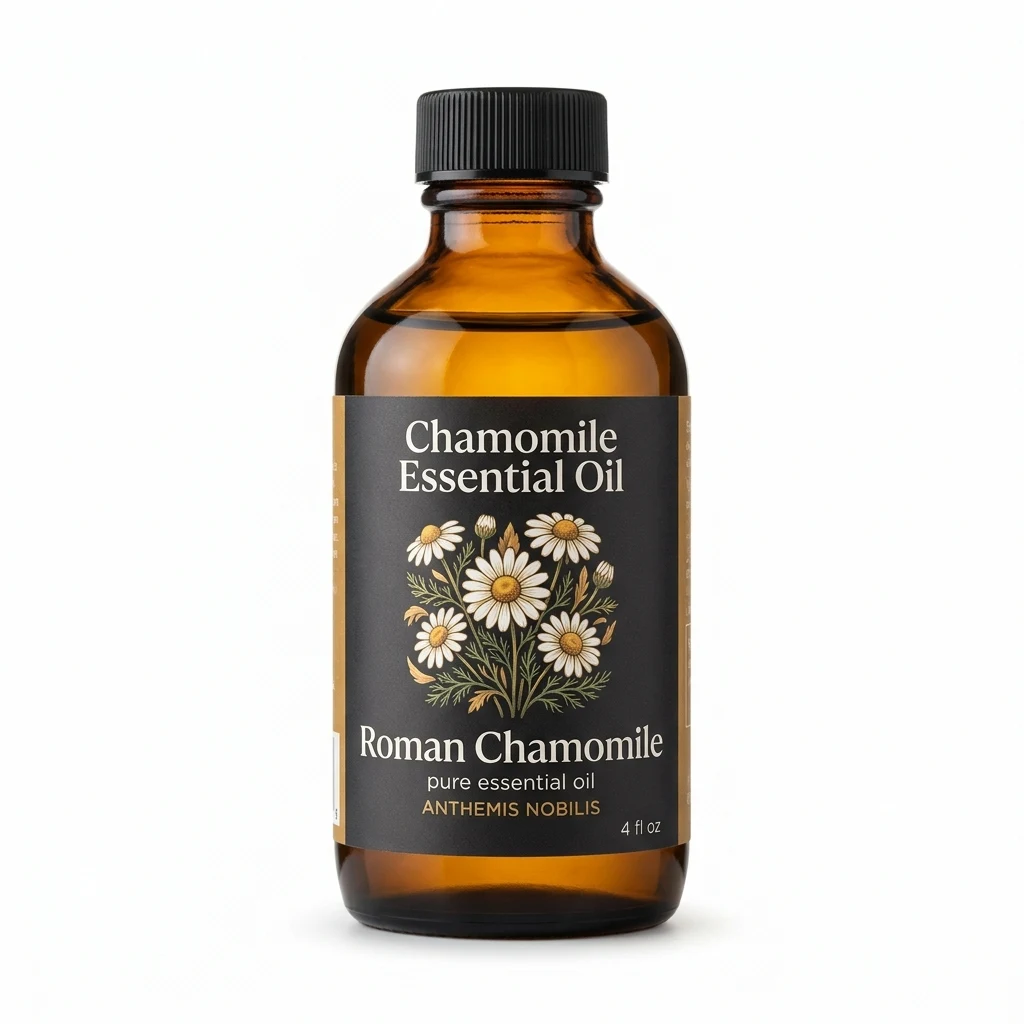
Roman Chamomile Essential Oil
Our own Roman Chamomile Essential Oil, in sizes from 0.5 oz to bulk.
From $32.99
Shop Now →Start with the question that sorts them: what is the bottle mostly made of?
| Material | Mostly made of | How it is made | Blue colour from chamazulene? |
|---|---|---|---|
| Essential oil (steam or hydrodistilled) | Volatile terpenes and esters from the flowers | Steam passes through flower heads; the oil is separated from the water | Yes in German chamomile oil, because chamazulene is made during distillation |
| Infused (macerated) oil | A carrier oil such as sunflower or olive, with a small amount of plant material dissolved in it | Flowers steeped in the carrier oil, then strained | No reason to expect it (reasoning below) |
| CO2 extract | In one published case, mostly waxes (12.1 to 97.4% of extract mass) | Supercritical CO2, sometimes with ethanol as a co-solvent | Not reported in the study we read |
The blue colour column is the quickest way to see that these are not interchangeable. According to a 2026 review in Nutrients (Such et al.), chamazulene is "formed thermally from matricin, a guaianolide sesquiterpene lactone, during steam distillation," and is not present in the fresh plant. Our own explainer on the blue colour covers the chemistry in more depth. The consequence, reasoning from that statement: a flower steeped cold or warm in a carrier oil has not been through distillation, so a blue infused oil would be a surprise worth questioning.
Essential oil: potent, so the work is dilution
An essential oil is the concentrate. How concentrated depends on the plant and where it grew. A 2010 Natural Product Research study of German-chamomile oils from European countries (Orav, Raal and Arak, PMID 20013472) reported chamazulene from 0.7% to 15.3% and bisabolol oxide A from 3.1% to 56.0% across its samples. The Such review quotes a higher chamazulene range, about 13.5 to 31.2%, depending on population and processing. The two sources disagree, and both are fair reports of different samples. The lesson is that "chamomile oil" is a range, not a number.
Worked example of why this matters when you use it: suppose an oil carried 10% chamazulene (an arithmetic example, not a claim about any bottle of ours). Diluted to 1% in a carrier, the finished blend would hold 0.1% chamazulene. At the 0.5% to 2% skin range on our product pages, the same oil would deliver 0.05% to 0.2%. Our oils are sold undiluted with no carrier in the bottle, so that arithmetic is yours to do, and our dilution guide shows the drops-per-ounce version (the German product page says roughly 3 to 12 drops per ounce).
Choose it when the finished product needs an aroma or a small, controlled dose: a diffuser blend, a linen spray, a perfume, a skin oil you dilute yourself. The German oil is the blue one; the Roman oil is the apple-like, ester-led one. The ester difference is documented: a 2026 Molecules study by Radulovic and Mladenovic found 190 constituents in two Serbian commercial Roman chamomile oils, led by a series of angelate esters, with 2-methylpropyl angelate at 11.9 to 13.9%. See the Roman versus German comparison for how that translates into smell and use.
Infused oil: a different product, made at home or bought
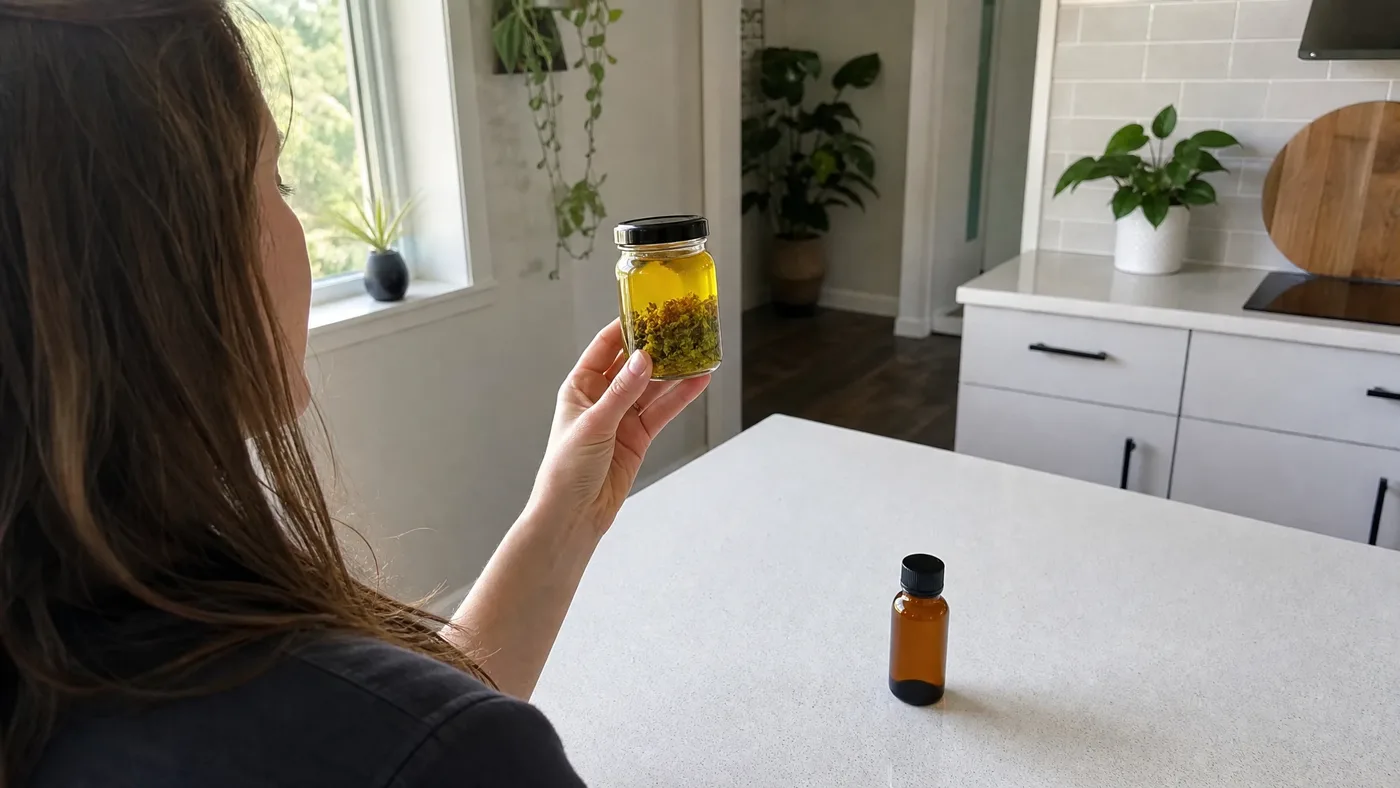
An infused oil is a vegetable oil that steeped with flowers. The Such review notes that a hot-water infusion carries only about 10% of the essential oil constituents into the liquid; it also notes that polar solvents pull out polyphenols and other material an essential oil lacks. Oil is a non-polar solvent, so reasoning from this, an infused oil will hold fat-soluble plant material, but we found no published analysis of a chamomile infused oil and will not give you a composition or a strength for one. It is also not diluted essential oil: if you want to follow the carrier-plus-essential-oil route, that is the dilution maths above. Our home infusion post covers making one; we do not repeat the method here, and we do not sell infused oil.
Choose it when you want a ready-to-use carrier with a plant character and no concentration decisions to make. Ask the maker for the base oil, the flower-to-oil ratio and the date; a label that gives none of these tells you little.
CO2 extract: the one with the least public data
For CO2 we have one useful primary source. A 2023 Antioxidants paper by Pastare et al. ran pilot-scale supercritical CO2 with ethanol on white ray florets, a by-product of processing organic German chamomile, across pressures of 5 to 25 MPa and temperatures of 20 to 55 °C. Waxes made up 12.1% to 97.4% of extract mass, essential-oil components 0.1% to 28.7%, and the extracts also held sterols, triterpenes and the coumarin herniarin. Bisabolol oxides A and B appeared, but the paper did not report chamazulene. The study did not compare these extracts with steam-distilled oil, and it used ray florets, not whole flower heads, so it describes one by-product stream, not "CO2 chamomile" in general.
The practical reading: a CO2 extract can be a thick, waxy material suited to cosmetic formulating, and its composition depends on the conditions the producer chose. Ask the seller for the extraction conditions and a composition report, as with any chamomile product. We do not sell CO2 extracts or absolutes; solvent-extracted absolutes and concretes exist in the trade, but we found no published chamomile absolute analysis, so we make no claims about them.
A short decision path
- Do you want an aroma or a blue colour in the finished product? Distilled essential oil, German for the blue.
- Do you want a ready-made carrier with no dilution step? An infused oil from a supplier that states the base oil and the date.
- Are you formulating a cosmetic and want waxes and non-volatiles in the ingredient? Ask a CO2 supplier for the extraction method and report.
- Is the use medical? None of these is a substitute for advice. The European Medicines Agency's chamomile flower monograph rests on traditional use, notes insufficient clinical-trial evidence, and says to consult a doctor if symptoms persist beyond a week. A pharmacist or physician is the right person for that question.
Who should skip, and limits
The EMA warns against use by people allergic to chamomile or other Asteraceae plants, and reports severe allergic reactions when liquid chamomile preparations touch inner mouth surfaces; none of these materials is for swallowing. For babies, pregnancy, or pets, see a pediatrician, an OB-GYN or midwife, or a veterinarian. Patch test any new product on a small area first, and see an allergist or dermatologist if you have a history of reacting to daisy-family plants.
If distilled chamomile is what you want, the German and Roman oils are the two we sell, undiluted, in nine sizes each; the infused oil and CO2 extract are products to source from specialist suppliers.
Roman Chamomile Essential Oil
Roman Chamomile Essential Oil from our own shop, in sizes from 0.5 oz to bulk.
From $32.99
Shop Now →Sources & Further Reading
- Such S, et al., 2026. German and Roman chamomile: species-specific phytochemical profiles. Nutrients. pmc.ncbi.nlm.nih.gov/PMC13363751
- Orav A, Raal A, Arak E, 2010. Content and composition of the essential oil of Chamomilla recutita from some European countries. Nat Prod Res. pubmed.ncbi.nlm.nih.gov/20013472
- Radulovic NS, Mladenovic MZ, 2026. Roman chamomile (Anthemis nobilis L.) essential oil: new esters. Molecules. pmc.ncbi.nlm.nih.gov/PMC12843988
- Pastare L, et al., 2023. Supercritical fluid extraction of Matricaria chamomilla white ray florets. Antioxidants. pubmed.ncbi.nlm.nih.gov/37237958
- European Medicines Agency, 2016. Matricariae flos, herbal medicinal product summary. ema.europa.eu/matricariae-flos